


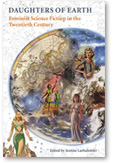
 Daughters of Earth is a complete introdfiction to twentieth-century feminist science fiction, bringing together eleven of the best short stories from the genre’s beginnings to the early twenty-ffirst century. Each story is accompanied by an essay that examines the story and its author, illuminating their place within the history of science fiction and feminism.
The earliest tale was first published in 1927 in Amazing Stories the first English-language magazine dedicated to science fiction (or “scientifiction” as it was known then). Amazing is where the science fiction community and fandom were born.1 The most recent story first appeared online in 2002 at scifiction,2 scifi.com’s fiction site. This change in venue echoes the changes in the science fiction community over this period: seventy years ago all the debates, conversations, arguments, and ranting that were (and are) such an important part of the community were found in the pages of science fiction magazines and fanzines; now that conversation is predominantly found online.
Some of these stories have been out of print and unavailable for years. Of the four earliest stories, only Leslie F. Stones’s “Conquest of Gola” (1933) has been reprinted in the last twenty years. Clare Winger Harris’s “The Fate of the Poseidonia” (1927) and Kate Wilhelm’s “No Light in the Window” (1963) have never been reprinted, and Alice Eleanor Jones’s “Created He Them” (1955) was reprinted only once in the year after its first appearance.3
Too many sf stories are published and then disappear,4 and of the stories that are reprinted, too few have received any critical attention. I wanted to find a balance in this anthology between introducing people to long-out-ofprint stories they would never otherwise read and reprinting better-known works that have never been the subject of study. Certainly, the eleven stories in Daughters of Earth have not had much (in most cases, any) scholarly work done on them.
Daughters of Earth includes essays by eleven scholars working within the academy in Australia, Canada, the United Kingdom, and the United States, as well as one by the independent critic and science fiction writer L. Timmel Duchamp. Pioneers of science fiction and fantasy scholarship such as Brian Attebery, Jane Donawerth, and Veronica Hollinger are represented, as are relative newbies Joan Haran, Cathy Hawkins, Josh Lukin, Wendy Pearson, and Lisa Yaszek, all of whom received their Ph.D.’s within the last five years.
While Daughters is aimed squarely at newcomers to feminist science fiction, there’s still plenty here for connoisseurs of the field. I was unaware, until I read Lisa Yaszek’s wonderful essay, that Alice Eleanor Jones had written romances as well as science fiction, as well as a great deal of commentary about writing for popular fiction magazines. Nor was I aware of how little I knew about the black history of science fiction until I read Andrea Hairston’s extraordinary essay in praise of that prophetic artist, Octavia Butler.
Feminism
But what is feminism? Is a story feminist merely because it is about women? Or written by a woman? Can a story that has no women in it be feminist? Can a man write a feminist story? Are all the stories in this collection feminist?
I can imagine definitions that would not count Harris’s “The Fate of the Poseidonia” as feminist or would reject Wilhelm’s “No Light in the Window.” Indeed, Josh Lukin’s eloquent essay about the Wilhelm story addresses the feminism of the story in great detail. As does Lisa Yaszek in her discussion of Alice Eleanor Jones’s “Created He Them.” The feminism of those stories can be argued with, but no one can question the feminist perspectives of the essays about the stories. This is not a fine distinction. Feminism is as much a way of reading as it is a way of writing.
This is not to imply that each essay is informed by the same kind of feminism. Definitions of feminism are varied, as are understandings of feminist science fiction’s history. Joan Haran’s essay verges on utopian when she writes of the political possibilities for change presented by Pat Murphy’s “Rachel in Love,” while L. Timmel Duchamp’s view of contemporary feminism in her essay on Karen Joy Fowler’s “What I Didn’t See” verges on the pessimistic.
Science Fiction
Perhaps even trickier than defining feminism is the question, What is science fiction? Long and detailed arguments about the genre’s borders and historical precedents have been raging since the advent of science fiction magazines in the 1920s.
I have long believed, along with Damon Knight, that something that is published as science fiction and read as science fiction is science fiction. However, even sf readers with a less elastic understanding of the field will find that the stories in this collection meet most people’s definitions. Many are set in outer space or involve intfirstellar travel (“The Fate of the Poseidonia,” “Conquest of Gola,” “No Light in the Window,” “And I Awoke and Found Me Here on the Cold Hillside,” and “Wives”); set in post-apocalyptic futures (“Created He Them” and “Balinese Dancer”); treat directly with scientific theory and practice (“Heat Death of the Universe,” “Rachel in Love,” “The Evening and the Morning and the Night,” and “Balinese Dancer”); or first contact (“And I Awoke and Found Me Here on the Cold Hillside” and “What I Didn’t See”).
Two of the stories have had their science-fictionness questioned: “Heat Death of the Universe” and “What I Didn’t See.” The essays about them by Mary Papke and L. Timmel Duchamp make compelling cases for their inclusion within the genre of science fiction—and more precisely, within feminist science fiction.
The Twentieth Century
Even the question of how to define the twentieth century is not straightforward. Did it end in 1999 or the year 2000? An astute reader will notice that the last story in this collection, Karen Joy Fowler’s “What I Didn’t See,” was originally published in 2002, which is in the twenty-first century no matter where you place the millennium’s edge. Why include it? As L. Timmel Duchamp demonstrates, “What I Didn’t See” is a story about twentieth-century feminist science fiction, neatly bringing together many of the themes, ideas, and issues of the genre and that century. Most particularly, of course, the story is shaped by and comments on the life and writings of that quintessentially twentieth-century feminist sf figure: James Tiptree Jr., whose shadow lies across many of the essays in this collection.
Omissions
I let my essayists decide which story they wanted to write about, which meant that some stories that I wish could have been included weren’t. It also led to no story from the 1940s being included, the only decade missing from these pages.5 Of course, one of the advantages of allowing essayists to choose their own stories is being able to pass the buck when this anthology is accused of terrible omissions. “Well,” I can say, “they chose the stories, you know, not me.” But in all honesty, even if I had selected each one, the end result would have been the same: many extraordinary, important, brilliant feminist sf stories would still have been omitted. Stories like Joanna Russ’s “When It Changed” (1972), Ursula K. Le Guin’s “The Ones Who Walk Away from Omelas” (1973), and Suzy McKee Charnas’s “Boobs” (1989).
Daughters of Earth was always going to leave out stories critical to shaping the genre, no matter who made the selections. As a result this anthology cannot possible claim to represent twentieth-century feminist science fiction exhaustively. But it can lay claim to opening up new understandings of the stories assembled here and thus of feminist sf in its first century of existence.
The omission of stories by the three giants of feminist science fiction— Suzy McKee Charnas, Ursula K. Le Guin, and Joanna Russ—was particularly hard. The impact on the genre of Charnas’s Holdfast series and of the stories, novels, and criticism of Le Guin and Russ was, and is, enormous. Quite simply, this book would not exist without them.
There are too many other omissions to list them all. There are writers who weren’t included because I couldn’t secure the rights, because they don’t write short stories, because their work has been so thoroughly written about already, or simply because no matter how wonderful their stories, there were only ever going to be eleven in this collection. Some of the other extraordinary feminist science fiction writers of the twentieth century are Samuel R. Delany, Sonja Dorman, L. Timmel Duchamp, Carol Emshwiller, Nalo Hopkinson, Leigh Kennedy, Kelly Link, Anne McCaffrey, Katherine McLean, Judith Merril, C. L. Moore, Kit Reed, Margaret St Clair, and Connie Willis. I hope this book will give those of you have not read feminist science fiction before a taste for more. Hunt out the names I mention here, and others that are mentioned in the essays. Read them. You’ll not regret it.
The collection’s title comes from Judith Merril’s superb 1952 novella, “Daughters of Earth,” which serves as a reminder that women have written science fiction for as long as the genre has been around, and that science fiction is always about the here and now, about this place were humans live.
We are all children of earth.
Notes
1. For the full story, see my The Battle of the Sexes in Science Fiction, 15– 38.
2. That’s right, “scientifiction” with the “enti” left out. Coincidence? Probably. But it’s a cool one.
3. And by the same people. The story originally appeared in the June 1955 issue of The Magazine of Fantasy and Science Fiction and was then reprinted in The Best from Fantasy and Science Ffiction: Fifth Series, edited by Anthony Boucher (Doubleday, 1956).
4. These disappearings happen because many sf stories were originally printed in sf magazines and have only rarely been reprinted. There are very few public collections of these magazines—and even if you can get hold of the magazines, many are in very bad shape: I have had the awful experience of carefully turning the page of a pulp magazine only to feel it crumble beneath my gloved hands. Heartbreaking.
There is an urgent need for these stories to be preserved.